Don't Start with Tools
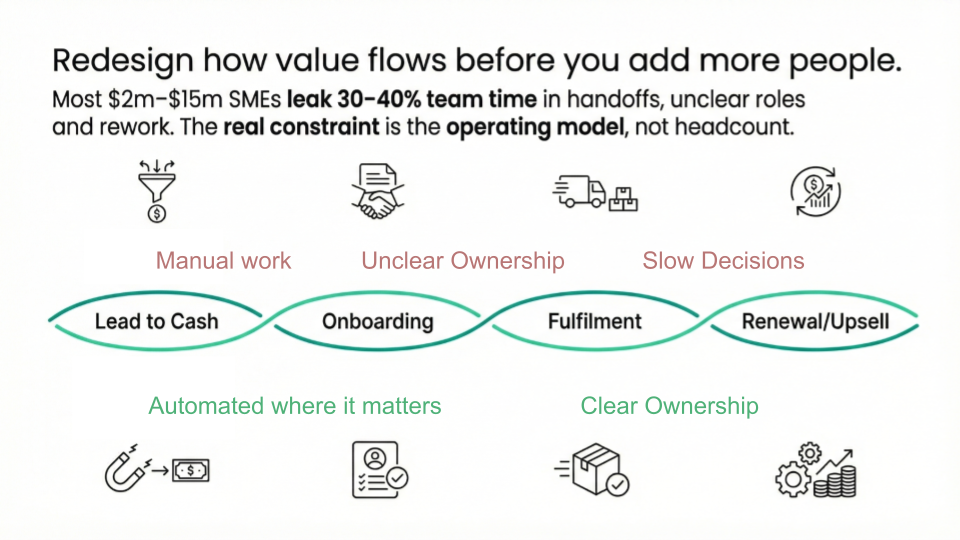
Your next AI project shouldn't start with a tools list. It should start with a profit leak list: top 3 places you're bleeding time, customers, or margin every week.
Don't Start with Tools
Your next AI project shouldn't start with a tools list. It should start with a profit leak list: top 3 places you're bleeding time, customers, or margin every week.
Most teams start with the shiny stuff: tools, models, platforms. But tools don't fix unclear offers, leaky processes, or bad data. They just make the chaos faster.
If you're not doing the business analysis and organisational/process change first then you don't have an AI/Automation Strategy — you have an AI/Automation Hobby.
Profit usually leaks in really unglamorous places:
-
Work your best people are doing manually every single week (approvals, reconciliations, reporting).
-
Customers dropping out at the same step in your funnel, and nobody owning that drop-off.
-
Orders, invoices, or tickets that always need rework because data is wrong or incomplete.
-
Handovers between teams where things "fall through the cracks" and nobody notices until the customer complains.
If you skip this discovery work and jump straight to "What AI tool should we use?", you end up with pilots, demos, and dashboards that look impressive but don't move revenue, margin, or capacity in any meaningful way.
A better sequence looks like this:
- Find the leaks — where are time, money, or customers quietly bleeding out?
- Put a number on them — even a rough estimate of wasted time or lost revenue changes the conversation.
- Redesign the workflow and possibly the organisation — clarify who does what, when, and with which data.
- Then pick the simplest tech that reliably closes that gap and estimate the cost of implementing it.
- Fix each leak on an ROI basis
Tools come last. The business problem comes first. If the question changes from "Which AI tool?" to "Which leak are we fixing this quarter?", everything else gets sharper.