Intent Decay
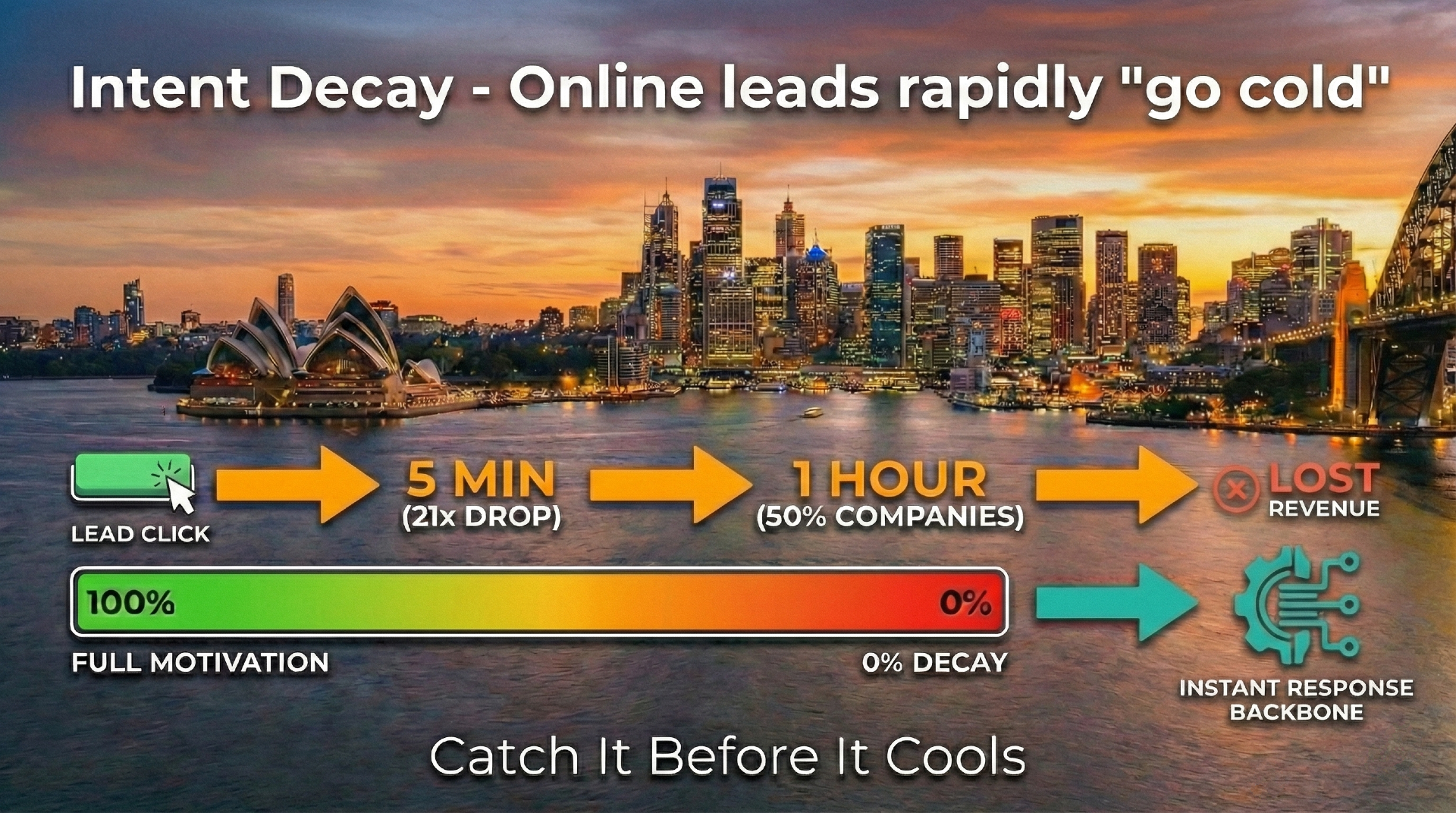
Online leads rapidly 'go cold'. Harvard found it: wait more than 5 minutes to call a lead, and you're 21x less likely to land them. When opportunity knocks and no one answers — that's a systems problem.
Intent Decay
Online leads rapidly "go cold"... Harvard found it: wait more than 5 minutes to call a lead, and you're 21x less likely to land them. When opportunity knocks and no one answers — that's not a marketing problem. It's a systems problem.
Most firms waste marketing spend by treating leads like traditional sales opportunities instead of urgent, time-sensitive signals.
A Facebook ad, a click, a form filled... and silence. Minutes pass. The buyer's motivation cools. By the time someone follows up, the lead — and the opportunity — is gone.
That's intent decay. And it's quietly eating margin inside mid-market businesses every day.
The brutal math of intent decay
Harvard Business Review data reveals: Companies contacting leads within 1 hour were 7x more likely to qualify them, while those waiting 24+ hours were 60x less likely. Yet over 50% of firms take more than 1 hour to respond — with popular studies citing even 21x drops after just 5 minutes.
Now, most leaders reading this aren't running gyms — but the same dynamic shows up everywhere:
- Service inquiries waiting in shared inboxes
- Quotes delayed while staff "find time"
- Operations data stuck between CRM and finance systems
It's the same root cause — leaky process design.
When business leaders tackle this, the first move isn't automation. It's redesign:
- Map the real-world flow of leads, orders, or requests.
- Clarify who owns each response and what "fast enough" means.
- Only then apply automation or AI to lock in the rhythm.
That's how intelligent operations are built — consulting-first, with deliberate design of strategy, structure, and processes to create a solid business IT backbone infused with knowledge, intelligence, policies and automation, then tools second.
Leaders often think they have a sales problem when, in reality, they have a response-system problem.
Where in your business are opportunities quietly leaking away while the team is "too busy running things"?