Making AI Actually Work for Your Business
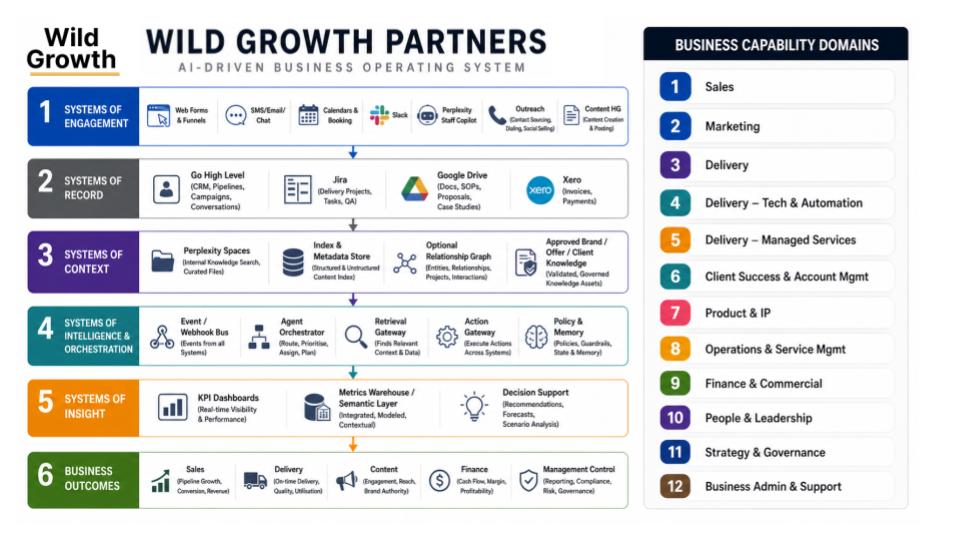
Most businesses don't have an AI problem — they have an integration and prioritisation problem. Here's how to build an AI backbone that grows with you and keeps working as AI and tools evolve.
How to build an AI backbone that grows with you and keeps working as AI and tools evolve.
Most businesses don't have an AI problem. They have an integration and prioritisation problem.
They've bought the tools. They've tested the prompts. They've played with content generation, sales assistants, dashboards, automation, and research copilots.
But instead of getting leverage, they get a mess:
- AI outputs disconnected from the CRM
- content disconnected from offers
- sales activity disconnected from delivery
- dashboards disconnected from reality
That's why AI often feels exciting in demos and underwhelming in operations.
The image above shows a better way to think about it.
Not as "which AI tool should we buy next?"
But as: How do we prioritise the highest-ROI AI opportunities, and, as we go, build the backbone we need to take us into the future?
That is the shift.
Start with ROI, not architecture
A lot of AI advice gets the order wrong. It says:
- Build the platform
- Build the architecture
- Build the governance model
- Then go find use cases
That is too slow, too abstract, and too expensive for most real businesses. A phased AI operating model works better when organisations focus first on high-value workflows, then harden governance and infrastructure as those wins prove out.
The smarter path is:
- Identify a small number of high-ROI AI opportunities.
- Pick the ones with clear business value, reasonable feasibility, and fast time-to-impact.
- Build the minimum viable backbone needed to make those opportunities real and repeatable.
- Reuse and expand that backbone for the next opportunity.
In other words:
Don't start by building a giant AI backbone. Build the backbone by shipping ROI slices.
That is how AI becomes an operating capability instead of a collection of experiments.
What the image is really showing
The left side of the image is the operating architecture. The right side is the capability view of the business.
Together, they show something important: every meaningful AI opportunity cuts across multiple layers of the business, which is why single-tool fixes usually fail. Enterprise AI models increasingly separate systems of engagement, record, context, intelligence, and insight so AI can operate with control rather than as disconnected point solutions.
1. Systems of Engagement
This is where work starts:
- web forms and funnels
- SMS, email, and chat
- calendars and booking
- Slack
- Perplexity or other AI front ends as a staff copilot
- Outreach
- Content production
This layer is where leads come in, conversations happen, content gets produced, and staff interact with each other and AI day to day.
These tools matter, but they are not your business backbone. They are your interaction layer.
2. Systems of Record
This is where truth lives:
- CRM
- Project management tools
- Document drives
- Accounting system
If a client, opportunity, project, invoice, or approved document matters to the business, there needs to be a clear system of record for it. Systems of record remain the backbone of enterprise data and financial control, even as AI layers expand above them.
This is one of the biggest mistakes businesses make with AI. They let the "smart" tool become a shadow source of truth.
That always ends badly.
3. Systems of Context – your knowledgebase
This is the layer most businesses are missing:
- Perplexity or other AI Spaces
- indexed and tagged knowledge
- optional relationship graph
- approved brand, offer, and client knowledge
AI is only as useful as the context it can access. A strong AI operating model depends on a governed knowledge layer that gives models and agents the right definitions, sources, and business meaning.
This is where documents stop being a random folder and start becoming usable business intelligence.
4. Systems of Intelligence and Orchestration
This is where AI becomes operational, where intelligent coordination and automation of workflows happen:
- event and webhook bus
- agent orchestrator
- retrieval gateway
- action gateway
- policy and memory
This layer coordinates what happens when something important occurs in the business. Modern agentic AI models depend on orchestration, policy control, and bounded tool access so AI can move from text generation into governed action.
Instead of "someone asks ChatGPT something", this layer supports patterns like:
- a lead comes in
- the system enriches it
- retrieves relevant context – customer history, organisational policies, product information, sales scripts and strategy
- drafts the right response
- updates the CRM
- alerts the right person
- and tracks the outcome
That is a real operating model.
5. Systems of Insight
This is where leadership sees what is working:
- KPI dashboards – Visual, at-a-glance views that show your most important numbers (like revenue, conversion, utilisation) so leaders can see how the business is performing right now.
- Decision support – Tools and models that sit on top of your data to highlight patterns, risks, and opportunities, helping leaders choose what to do next rather than just stare at charts.
- A semantic layer – A central, cleaned-up data layer that standardises definitions (e.g. what exactly is "qualified pipeline" or "churn") so every report and AI agent is working from the same version of the truth.
The point of AI is not more activity. The point is better decisions and better outcomes.
If you can't see whether AI is improving conversion, delivery speed, margin, utilisation, retention, or management control, then you don't have AI transformation. You have AI noise.
6. Business Outcomes
This is the only part that really matters:
- sales
- delivery
- content
- finance
- management control
- etc
Everything above exists to improve these outcomes.
If the architecture doesn't improve one or more of them, it is over-engineered or mis-engineered.
Why the capability list matters
On the right side of the image is the list of business capability domains:
- Sales
- Marketing
- Delivery
- Delivery – Tech & Automation
- Delivery – Managed Services
- Client Success & Account Management
- Product & IP
- Operations & Service Management
- Finance & Commercial
- People & Leadership
- Strategy & Governance
- Business Admin & Support
This matters because businesses should not prioritise AI around tools alone. They should prioritise it around the capabilities that create value.
That means asking questions like:
- Where are we losing margin because work is manual, slow, or inconsistent?
- Where are we wasting senior time on repeatable judgement tasks?
- Where do we have high-value knowledge trapped in people, documents, or disconnected apps?
- Which capabilities could improve revenue, capacity, client experience, or control in the next 90 to 180 days?
AI use-case prioritisation works best when opportunities are scored for business value, feasibility, risk, and time-to-impact rather than novelty.
That is how you stop AI from becoming theatre.
What future-proofing actually means
Future-proofing does not mean choosing the perfect toolset now. That is fantasy.
Future-proofing means building a business where:
- systems of record remain clear
- context is organised and portable
- orchestration is modular
- policies are explicit
- insight is measurable
- tools can change without breaking the operating model
That is how you build something that grows with you as AI and tools evolve. Governance and architecture only become strategic assets when they let organisations scale proven use cases safely instead of restarting every time the tool landscape shifts.
Final thought
The businesses that win with AI won't be the ones that did the most experiments. They'll be the ones that:
- picked the right opportunities
- proved value quickly
- and used each win to build more backbone underneath the business that then creates leverage in future AI implementations
That is how AI stops being a distraction and starts becoming infrastructure.
Not by starting with the backbone. By building it, one high-ROI move at a time.