Where Profit Lives
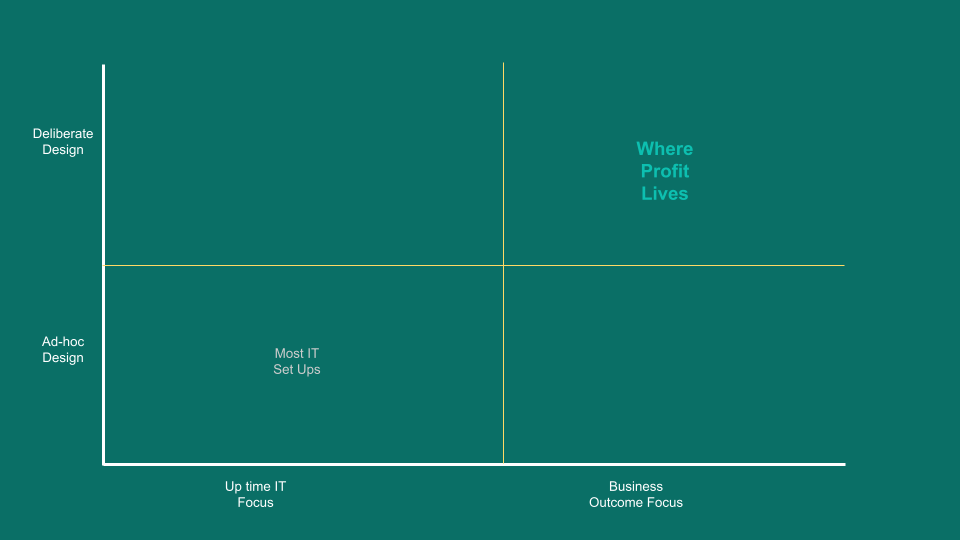
If your IT partner talks more about tickets, tools, and uptime than profit, agility, and throughput, you don't have a technology strategy — you have a cost centre.
Where Profit Lives
If your IT partner talks more about tickets, tools, and uptime than profit, agility, and throughput, you don't have a technology strategy — you have a cost centre. Which of those three do they measure first?
If your IT partner can quote uptime but can't explain how they're growing your profit, you're optimising the wrong KPI. "Always on" is not the same as "better business."
In mid-market ($1m to $15m revenue), operations-heavy businesses, the useful question isn't "Is our system up?" but "Did today's work get done faster, cleaner, and more profitably than last quarter?" That's the gap between IT that maintains infrastructure and IT that helps you build a more agile organisation — where structure, processes, and people are aligned around value, not tickets.
On real Tuesday mornings, the leaders worth listening to are asking:
- Where are policies, approvals, and hand-offs slowing down revenue or service delivery?
- Which roles are unclear, duplicated, or still built around old ways of working?
- Which processes would break if one key person was sick or resigned this week?
In the best-run environments, the pattern is consistent:
-
Diagnose — get clear on what's broken, where value, profit, and expenses are leaking, and what actually matters commercially so you're solving the right problem, not decorating reports.
-
Design the business — priorities, operating model, processes, roles, and who decides what — so technology is an enabler, not a distraction.
-
Deliver the right solutions — fix operational drag, automate and integrate where it truly counts, and explore the use of AI to make your business more intelligent.
-
Run & Improve — measure outcomes, optimise operations, and strengthen systems over time so information, decisions, and work can flow while improving the metrics that count: profit, customer satisfaction, and staff satisfaction.
In one large industrial environment, centralising operations and redesigning workflows, roles, and escalation paths before any major tech change delivered fewer incidents and a step-change in throughput — not because tools were new, but because the business itself had been restructured to move faster and make better decisions.
When you look at your current IT partner, are they helping you rethink how your organisation creates and protects profit, or are they just keeping a dashboard green?